Eighty years of comprehensive resilience and security of supply
Finland is known for its exceptional collaboration between the public and private sectors. Companies are more than participants – they drive the development of innovative and practical solutions.
Companies play the most central role in the area of security of supply. Ninety per cent of Finland’s critical infrastructure is owned, managed, and operated by private-sector companies.
Finland stands out in Europe as one of the few countries to have invested in resilience in a sustained and systematic way – uninterrupted since the end of the Second World War.
Finland’s unique Comprehensive Security Model covers every aspect of society: from public administration and the private sector to NGOs and citizens. In the event of a crisis, Finnish society as a whole will be able to react swiftly and recover rapidly from disruptions.
At the heart of the Finnish model is seamless partnership between the public and private sectors. Companies play the most central role in the area of security of supply. In Finland this covers three aspects:
- Material preparedness
- Protection of critical infrastructure
- Ensuring operational continuity
Role of companies
Private-sector companies play a pivotal role in Finland’s national resilience. This means that in addition to focusing on their own operations they develop solutions for their B2B customers and the public sector:
1) Companies designated as critical to the security of supply (1,500 in total)
Leading companies across vital business sectors are connected via a comprehensive network led by the National Emergency Supply Agency (Huoltovarmuuskeskus). The aim is to ensure the continuity of all vital functions during a crisis.
On an operational level, companies contribute participate through approximately thirty sector-specific pools, which include the Logistics Pool (supply chain optimisation), the Finance Pool (continuity of payment systems and banking services) and the Energy Pool (energy system resilience).
Notably, these 1,500 companies contribute on a voluntary basis, without legal obligation. In return, they gain benefits through joint development projects, risk management efforts, crisis exercises, and shared situational awareness.
2) Companies supporting crisis preparedness as part of supply chains
A considerably larger number of companies are involved through supply chains.
These solution providers serve not only the previously mentioned companies, but also a wider range of business customers and public-sector organizations.
3) Companies as owners of critical infrastructure
Ninety per cent of Finland’s critical infrastructure is owned, managed, and operated by private-sector companies.
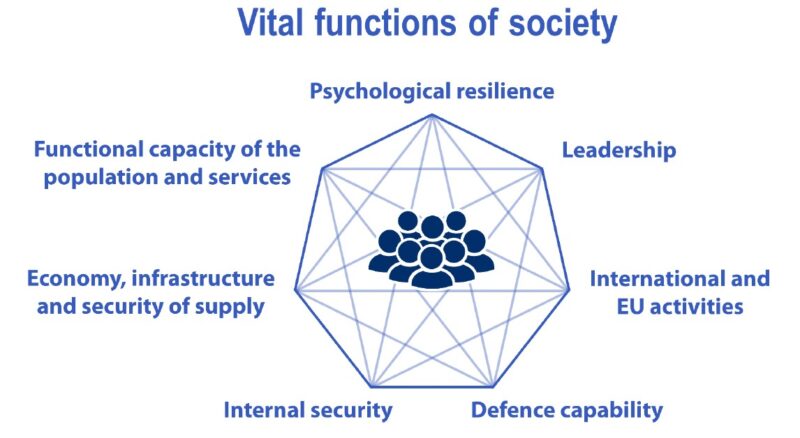
Illustration: The Security Committee
Contact: